
{Tool} Integration of pea into baking flour and its effects on bread sensory characteristics - IntercropVALUES Practice Abstract. Creator(s): Weedon, Odette. Issuing Organisation(s): IFOAM Organics Europe. (2026)
Preview |
PDF
- German/Deutsch
444kB |
Preview |
PDF
- English
396kB |
![[thumbnail of baking.png]](https://orgprints.org/id/eprint/57833/13/baking.png)  Preview |
Image (PNG)
- Cover Image
- English
202kB |
Summary
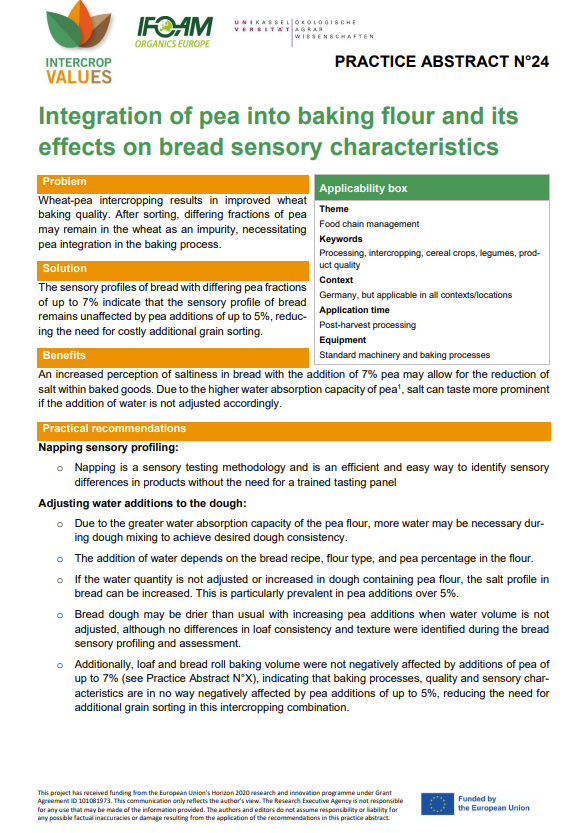
An increased perception of saltiness in bread with the addition of 7% pea may allow for the reduction of salt within baked goods. Due to the higher water absorption capacity of pea1, salt can taste more prominent if the addition of water is not adjusted accordingly.
Practical recommendations
Napping sensory profiling:
o Napping is a sensory testing methodology and is an efficient and easy way to identify sensory differences in products without the need for a trained tasting panel
Adjusting water additions to the dough:
o Due to the greater water absorption capacity of the pea flour, more water may be necessary during dough mixing to achieve desired dough consistency.
o The addition of water depends on the bread recipe, flour type, and pea percentage in the flour.
o If the water quantity is not adjusted or increased in dough containing pea flour, the salt profile in bread can be increased. This is particularly prevalent in pea additions over 5%.
o Bread dough may be drier than usual with increasing pea additions when water volume is not adjusted, although no differences in loaf consistency and texture were identified during the bread sensory profiling and assessment.
o Additionally, loaf and bread roll baking volume were not negatively affected by additions of pea of up to 7% (see Practice Abstract N°X), indicating that baking processes, quality and sensory characteristics are in no way negatively affected by pea additions of up to 5%, reducing the need for additional grain sorting in this intercropping combination.
| EPrint Type: | Practice tool |
|---|---|
| What problem does the tool address?: | Wheat-pea intercropping results in improved wheat baking quality. After sorting, differing fractions of pea may remain in the wheat as an impurity, necessitating pea integration in the baking process. |
| What solution does the tool offer?: | The sensory profiles of bread with differing pea fractions of up to 7% indicate that the sensory profile of bread remains unaffected by pea additions of up to 5%, reducing the need for costly additional grain sorting. |
| Country: | Germany |
| Type of Practice Tool: | Practice abstracts |
| Keywords: | processing, intercropping, cereal crops, legumes, product quality |
| Agrovoc keywords: | Language Value URI English processing http://aims.fao.org/aos/agrovoc/c_6195 English intercropping http://aims.fao.org/aos/agrovoc/c_3910 English cereal crops http://aims.fao.org/aos/agrovoc/c_25512 English legumes http://aims.fao.org/aos/agrovoc/c_4255 English product quality http://aims.fao.org/aos/agrovoc/c_13591 |
| Subjects: | Crop husbandry > Crop combinations and interactions Food systems > Processing, packaging and transportation Food systems > Produce chain management |
| Research affiliation: | European Union > Horizon Europe > IntercropVALUES International Organizations > International Federation of Organic Agriculture Movements IFOAM > IFOAM Organics Europe Germany > University of Kassel > Department of Organic Farming and Cropping |
| Horizon Europe or H2020 Grant Agreement Number: | 101081973 |
| Related Links: | https://organic-farmknowledge.org/tool/57833, https://organic-farmknowledge.org/tool/53690, https://organic-farmknowledge.org/tool/53678, https://organic-farmknowledge.org/tool/57740 |
| Project ID: | ofk |
| Deposited By: | Bozsogi, B |
| ID Code: | 57833 |
| Deposited On: | 06 Jul 2026 06:54 |
| Last Modified: | 06 Jul 2026 06:54 |
| Document Language: | English, German/Deutsch |
| Status: | Published |
Repository Staff Only: item control page
 Download Statistics
 Download Statistics