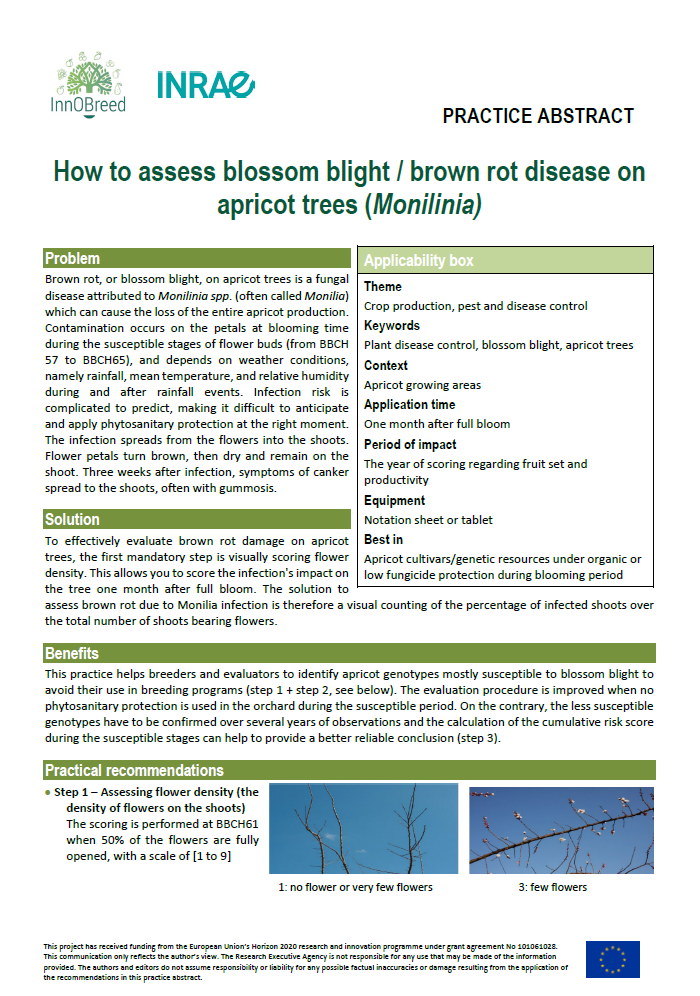

{Tool} How to assess blossom blight / brown rot disease on apricot trees (Monilinia). Creator(s): Tricon, David; Audergon, Jean-Marc and Brunet, Laurent. Issuing Organisation(s): INRAE - National Research Institute for Agriculture, Food and Environment. (2026)
![[thumbnail of InnOBreed_practice abstract_APRICOT Monilinia_FINAL.pdf]](/style/images/fileicons/application_pdf.png) |
PDF
- Published Version
- English
1MB |
![[thumbnail of cover image_apricot_monilia.png]](https://orgprints.org/id/eprint/58237/2/cover%20image_apricot_monilia.png) |
Image (PNG)
- Cover Image
- English
211kB |
Summary
This practice helps breeders and evaluators to identify apricot genotypes mostly susceptible to blossom blight to avoid their use in breeding programs (step 1 + step 2, see below). The evaluation procedure is improved when no phytosanitary protection is used in the orchard during the susceptible period. On the contrary, the less susceptible genotypes have to be confirmed over several years of observations and the calculation of the cumulative risk score during the susceptible stages can help to provide a better reliable conclusion (step 3).
| EPrint Type: | Practice tool |
|---|---|
| What problem does the tool address?: | Brown rot, or blossom blight, on apricot trees is a fungal disease attributed to Monilinia spp. (often called Monilia) which can cause the loss of the entire apricot production. Contamination occurs on the petals at blooming time during the susceptible stages of flower buds (from BBCH 57 to BBCH65), and depends on weather conditions, namely rainfall, mean temperature, and relative humidity during and after rainfall events. Infection risk is complicated to predict, making it difficult to anticipate and apply phytosanitary protection at the right moment. The infection spreads from the flowers into the shoots. Flower petals turn brown, then dry and remain on the shoot. Three weeks after infection, symptoms of canker spread to the shoots, often with gummosis. |
| What solution does the tool offer?: | To effectively evaluate brown rot damage on apricot trees, the first mandatory step is visually scoring flower density. This allows you to score the infection's impact on the tree one month after full bloom. The solution to assess brown rot due to Monilia infection is therefore a visual counting of the percentage of infected shoots over the total number of shoots bearing flowers. |
| Country: | France |
| Type of Practice Tool: | Practice abstracts |
| Keywords: | temperate fruits, plant disease control |
| Agrovoc keywords: | Language Value URI English temperate fruits http://aims.fao.org/aos/agrovoc/c_7655 English plant disease control http://aims.fao.org/aos/agrovoc/c_5960 |
| Subjects: | Crop husbandry > Production systems > Fruit and berries |
| Research affiliation: | European Union > Organic Farm Knowledge France > INRAe - Institut national de recherche pour l’agriculture, l’alimentation et l’environnement European Union > Horizon Europe > InnOBreed |
| Horizon Europe or H2020 Grant Agreement Number: | 101061028 |
| Related Links: | https://organic-farmknowledge.org/tool/58237, https://organic-farmknowledge.org/tool/44139, https://organic-farmknowledge.org/tool/44728 |
| Project ID: | ofk |
| Deposited By: | Dietemann, Lauren |
| ID Code: | 58237 |
| Deposited On: | 15 Oct 2026 13:46 |
| Last Modified: | 15 Oct 2026 13:46 |
| Document Language: | English |
| Status: | Published |
Repository Staff Only: item control page
 Download Statistics
 Download Statistics