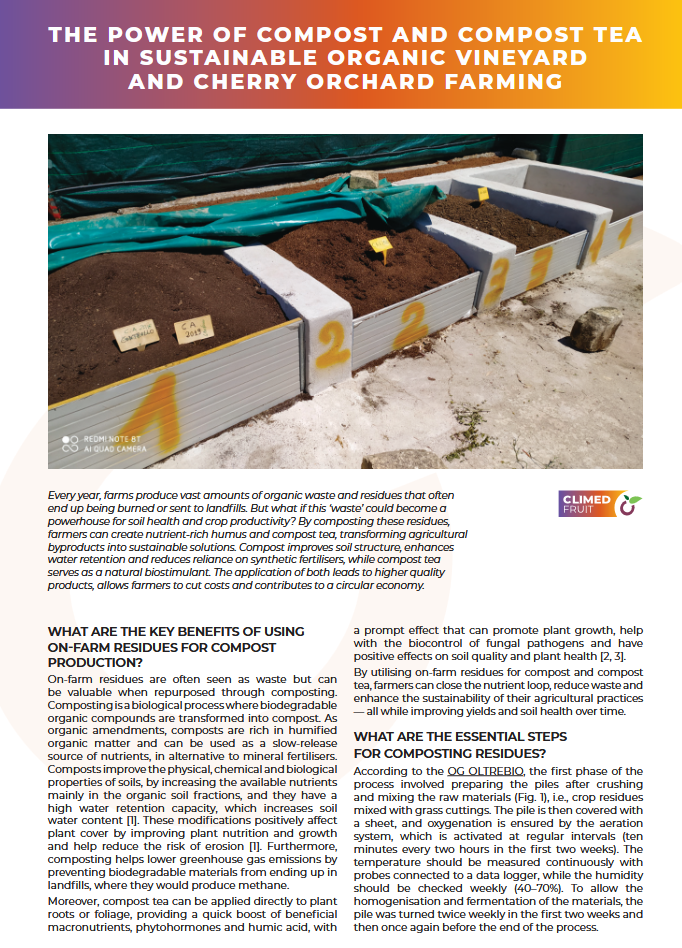

{Tool} The power of compost and compost tea in sustainable organic vineyard and cherry orchard farming. (2025)
![[thumbnail of Screenshot 2026-07-22 155039.png]](https://orgprints.org/id/eprint/57913/1/Screenshot%202026-07-22%20155039.png)  Preview |
Image (PNG)
- Cover Image
- English
582kB |
Preview |
PDF
- Published Version
- English
1MB |
Preview |
PDF
- Published Version
- Greek/Ellinika
465kB |
Preview |
PDF
- Published Version
- Spanish/Español
482kB |
Preview |
PDF
- Published Version
- Croatian/Hrvatski jezik
485kB |
Preview |
PDF
- Published Version
- French/Francais
1MB |
Preview |
PDF
- Published Version
- Italian/Italiano
478kB |
Preview |
PDF
- Published Version
- Portuguese/Portugues
482kB |
Document available online at: https://climed-fruit.eu/wp-content/uploads/2025/08/Compost-tea.pdf
Summary
This factsheet will teach you the following: 1) What are the key benefits of using on-farm residues for compost production?, 2) What are the essential steps for composting residues?, 3) How does compost tea differ from traditional compost and what are ist advantages?, 4) How is the compost tea produced?, 5) Different types of compost tea, 6) What challenged might farmers face when composting farm resoidues?, 7) What are the best practices for applying compost and compost tea in vineyards and orchards?
| EPrint Type: | Practice tool |
|---|---|
| Teaser: | Turning farm residues into a powerful tool for improving soil health and crop resilience. |
| What problem does the tool address?: | Every year, farms produce vast amounts of organic waste and residues that often end up being burned or sent to landfills. |
| What solution does the tool offer?: | But what if this ‘waste’ could become a powerhouse for soil health and crop productivity? By composting these residues, farmers can create nutrient-rich humus and compost tea, transforming agricultural byproducts into sustainable solutions. Compost improves soil structure, enhances water retention and reduces reliance on synthetic fertilisers, while compost tea serves as a natural biostimulant. The application of both leads to higher quality products, allows farmers to cut costs and contributes to a circular economy. |
| Country: | Italy |
| Type of Practice Tool: | Leaflets & guidelines |
| Agrovoc keywords: | Language Value URI English viticulture http://aims.fao.org/aos/agrovoc/c_8277 English grapes http://aims.fao.org/aos/agrovoc/c_3359 English nutrient management http://aims.fao.org/aos/agrovoc/c_330697 English composts http://aims.fao.org/aos/agrovoc/c_1795 |
| Subjects: | Crop husbandry > Composting and manuring Crop husbandry > Production systems > Fruit and berries > Viticulture Farming Systems > Farm nutrient management |
| Research affiliation: | European Union > Horizon Europe > OrganicClimateNET > selected tools European Union > Organic Farm Knowledge |
| Horizon Europe or H2020 Grant Agreement Number: | 101060474 |
| Related Links: | https://organic-farmknowledge.org/tool/57913, https://organic-farmknowledge.org/tool/45872, https://organic-farmknowledge.org/tool/55429, https://climed-fruit.eu/, https://organic-farmknowledge.org/tool/55493 |
| Project ID: | OFK |
| Deposited By: | Dietemann, Lauren |
| ID Code: | 57913 |
| Deposited On: | 27 Jul 2026 06:53 |
| Last Modified: | 11 Aug 2026 09:39 |
| Document Language: | English, Croatian/Hrvatski jezik, French/Francais, Greek/Ellinika, Italian/Italiano, Portuguese/Portugues, Spanish/Español |
| Status: | Published |
Repository Staff Only: item control page
 Download Statistics
 Download Statistics